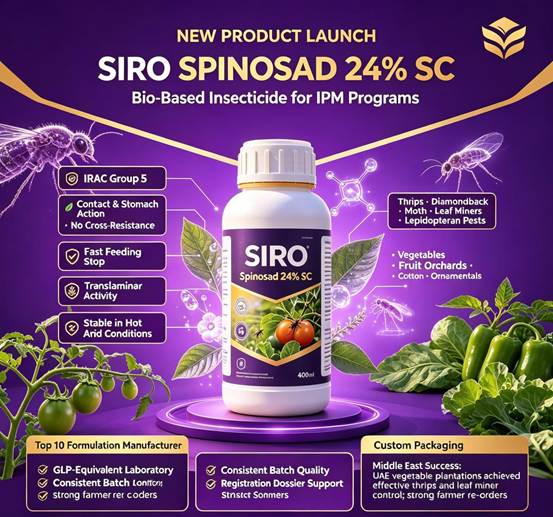
SIRO GROUP officially launches Spinosad 24% SC, a bio‑based suspension‑concentrate insecticide classified under IRAC Group 5. Derived from microbial fermentation, this product fits integrated pest‑management programmes and addresses widespread resistant‑pest challenges across global farmland, especially for Middle‑East commercial planting markets. Below are frequently‑asked questions for importers and potential business partners.
Q1: What are the core efficacy advantages of SIRO Spinosad 24% SC?
Spinosad delivers both contact and stomach poisoning activity with unique nervous‑system targeting mechanism, no cross‑resistance with pyrethroids, neonicotinoids or diamides抖音百科. After exposure, pests stop feeding quickly and die within 24‑48 hours. The SC formulation features fine particle size, outstanding spreadability and translaminar penetration, reaching pests hiding on leaf undersides. It maintains stable performance under high‑temperature, arid field environments typical in Middle‑East regions.
It effectively controls thrips, diamondback moth, leaf‑miners, fruit borers and various lepidopteran caterpillars. Suitable crops cover vegetables, tomatoes, peppers, fruit orchards, cotton and ornamental plants. With low mammalian toxicity and friendly profile towards beneficial insects under correct dosage, it is well‑suited for high‑value vegetable and organic planting systemsCorteva Ag…. Foliar spraying at early‑larval stages maximizes field control results.
Q2: Could you share SIRO’s successful sales case in the Middle East?
SIRO Spinosad series has achieved solid market performance in Gulf Cooperation Council countries. One representative case comes from large‑scale vegetable plantations in UAE. Local distributors introduced SIRO Spinosad products to combat rampant thrips and tomato leaf‑miner pressure in greenhouse and open‑field farms.
Faced with severe pest resistance against traditional chemical insecticides, local growers adopted SIRO Spinosad 24% SC within their IPM rotation scheme. Field trials showed obvious suppression of target pests, reducing overall pesticide application frequency. Thanks to stable batch quality and competitive wholesale pricing, this product gained high farmer acceptance. The local distributor realized fast inventory turnover and satisfying profit returns, expanding sales to surrounding Oman markets and building repeat‑order customer groups. This real‑world case fully proves field adaptability of SIRO Spinosad under hot, arid Middle‑East growing conditions.
Q3: Why choose SIRO‑branded Spinosad 24% SC rather than generic alternatives?
As one of China’s top‑10 pesticide‑formulation manufacturers, SIRO runs a 100 000‑KL‑per‑year intelligent production base. Every batch of Spinosad 24% SC goes through strict stability, suspension and particle‑size inspection before delivery, avoiding common defects such as sedimentation and stratification seen from small‑workshop suppliers.
Our GLP‑equivalent laboratory supports complete technical documentation including physical‑chemical testing, storage‑stability reports and residue data. These files can greatly accelerate local pesticide‑registration progress for Middle‑East and other regional partners.
We have accumulated rich export experience serving Middle‑East, Latin‑American, African and Southeast‑Asian markets. Besides bulk supply, we provide custom‑packaging options, timely spare‑document updates and professional agronomic technical support. Our after‑sales team helps distributors handle market feedback and lower operational risks. Unlike simple trading companies, SIRO guarantees consistent large‑batch quality for long‑term repeat orders.
Q4: What cooperation terms can SIRO offer global partners?
We sincerely recruit exclusive regional distributors worldwide for SIRO Spinosad 24% SC. Available support includes stable bulk supply, OEM/ODM customisation, registration‑dossier assistance, promotional material resources and regional‑market protection to secure partners’ profit margin.
Reach out to SIRO for samples, quotations and further discussion for mutually‑beneficial long‑term cooperation.