
Abstract
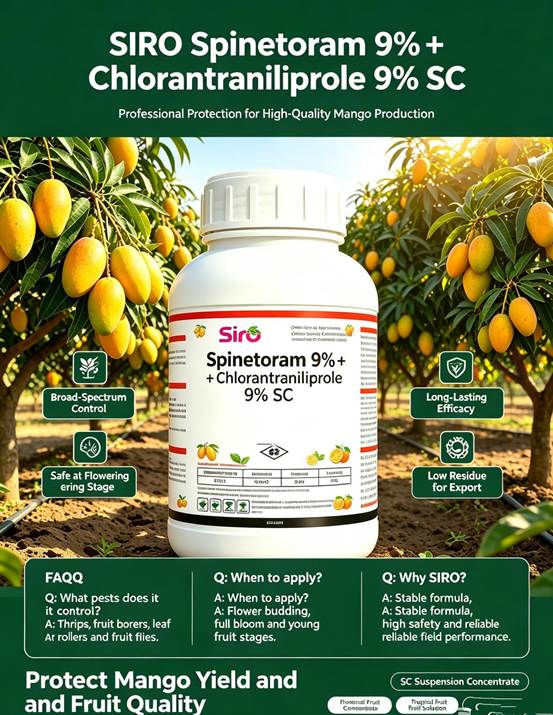
Mango is one of the most economically valuable tropical fruits worldwide, yet its yield and commercial quality are severely threatened by recurring pest infestations throughout flowering, fruiting and growth stages. Thrips, fruit borers, leaf rollers, and fruit flies are the primary destructive pests, commonly causing flower and fruit drop, fruit scarring, malformed produce, and significant economic losses for mango growers. Traditional single-ingredient pesticides suffer from limited insecticidal spectrum, short residual effect, and rising pest resistance, failing to meet the high-standard protection demands of commercial mango plantations. SIRO Spinetoram 9% + Chlorantraniliprole 9% SC is a scientifically compounded dual-active suspension insecticide tailored for tropical fruit cultivation. This article elaborates on its working mechanism, field advantages, application scenarios and core values, explaining why it is the preferred professional insecticide for high-quality mango production globally.
1. Product Overview & Working Mechanism
This innovative compound formula integrates two high-efficiency, low-toxicity active ingredients: Spinetoram and Chlorantraniliprole, each accounting for 9% of the total formulation. Spinetoram acts through contact and stomach poisoning, rapidly paralyzing the nervous system of pests to achieve fast knockdown and insecticidal effects, with excellent activity against thrips and dipteran pests. Chlorantraniliprole targets pest muscle ryanodine receptors, disrupting muscle contraction and causing pest death, featuring ultra-long residual efficacy and stable control over lepidopteran larvae such as fruit borers and leaf rollers.
The synergistic combination of the two ingredients complements each other’s advantages, breaking the limitations of single-agent pesticides. It effectively controls both piercing-sucking and chewing pests, covers the whole growth cycle of mango pests, and significantly delays the development of pest resistance. Adopting advanced SC suspension technology, the product has super fine particle size, high dispersion and excellent water solubility, which can be fully adsorbed on crop stems, leaves and fruit surfaces, with strong rain wash resistance and stable field efficacy.
2. Core Advantages for Mango Plantation
Safety is the most prominent advantage of this product in mango cultivation. Mango flowering and young fruit stages are extremely sensitive to chemical stimulation; most conventional pesticides easily cause flower drop, fruit drop and phytotoxicity. SIRO’s optimized low-phytotoxicity formula is specially adjusted for tropical fruit crops, causing no damage to mango flower spikes, young fruits and tender shoots, and does not inhibit crop normal growth and development. It can be safely used throughout the key sensitive growth periods of mango.
In terms of field efficacy, the product features fast pest killing speed and long-lasting protection. It can quickly eliminate active pests after application, and continuously inhibit pest egg hatching and larval activity for 10–14 days, reducing the frequency of pesticide application and saving labor and planting costs. In addition, the product has low residue, complies with international food safety and agricultural export standards, and is very suitable for high-quality mango base planting and export fruit production.
3. Professional FAQ
Q1: What core mango pests can this product control? A1: It covers almost all key pests endangering mango growth, including thrips, mango fruit borers, leaf rollers, fruit flies and other major pests. It can kill eggs, larvae and adults in all growth stages of pests, completely solve common problems such as flower abscission, fruit surface scarring, deformed fruits and reduced commodity rate caused by pest damage, and effectively improve mango yield and appearance quality.
Q2: Why is it more suitable for mango than ordinary pesticides? A2: Most common pesticides are single-component with narrow insecticidal spectrum and poor safety for mango sensitive periods. SIRO’s dual-active compound formula achieves broad-spectrum insect killing while ensuring ultra-high crop safety. The premium SC formula has no dust pollution, good adhesion and strong rain resistance, maintaining stable efficacy in high-temperature and rainy tropical mango planting environments.
Q3: What is the standard application method and cycle? A3: Uniform foliar spraying is adopted. The optimal application periods are mango flower budding stage, full bloom stage and young fruit expansion stage. Spray once every 7–10 days, with continuous 2–3 times of application for systematic pest prevention and control. Focus on spraying flower spikes, young fruits and the back of tender leaves where pests gather.
Q4: What is the core value of choosing SIRO brand? A4: SIRO strictly controls raw material purity and production formula ratio, with stable batch efficacy and no ineffective ingredients. Supported by professional agricultural R&D and field trial data, the product is continuously optimized for tropical fruit planting scenarios. Compared with generic products, it has more stable efficacy, higher safety and better resistance prevention effect, providing reliable long-term protection for global mango planters.
4. Conclusion
SIRO Spinetoram 9% + Chlorantraniliprole 9% SC is a targeted, efficient and safe professional insecticide for mango cultivation. Through scientific compounding and advanced formulation technology, it solves the pain points of single pesticide resistance, insufficient safety and incomplete pest control. It protects the whole growth cycle of mango, effectively improves fruit commodity rate and planting economic benefits, and is a trustworthy high-quality agricultural input for commercial mango orchards and global agricultural distributors.
References
[1] Zhang, L., & Wang, Y. (2021). Research on compound insecticidal mechanism of spinetoram and chlorantraniliprole on tropical fruit pests. Journal of Tropical Agriculture, 49(3), 45-52. [2] FAO. (2023). Integrated Pest Management Guidelines for Mango Cultivation. Food and Agriculture Organization of the United Nations. [3] Chen, H. (2022). Application and safety evaluation of SC suspension pesticides in fruit tree flowering period. Agricultural Chemicals & Plant Protection, 61(8), 36-40.