Introduction
The Middle East, North Africa and sub‑Saharan Africa are blessed with abundant sunshine, yet extreme heat, sharp day‑night temperature swings and sand erosion create huge challenges for photovoltaic equipment. Solar module surface temperatures often hit 65–75°C in summer, triggering power attenuation, hot‑spot damage and accelerated aging of ordinary panels中华人民共…. Meanwhile, a hidden business risk troubles local distributors, especially in markets such as Iran: many imported solar products circulate without official brand authorization. Unauthorized parallel imports carry severe after‑sales loopholes, trademark disputes and intellectual‑property litigation risks.
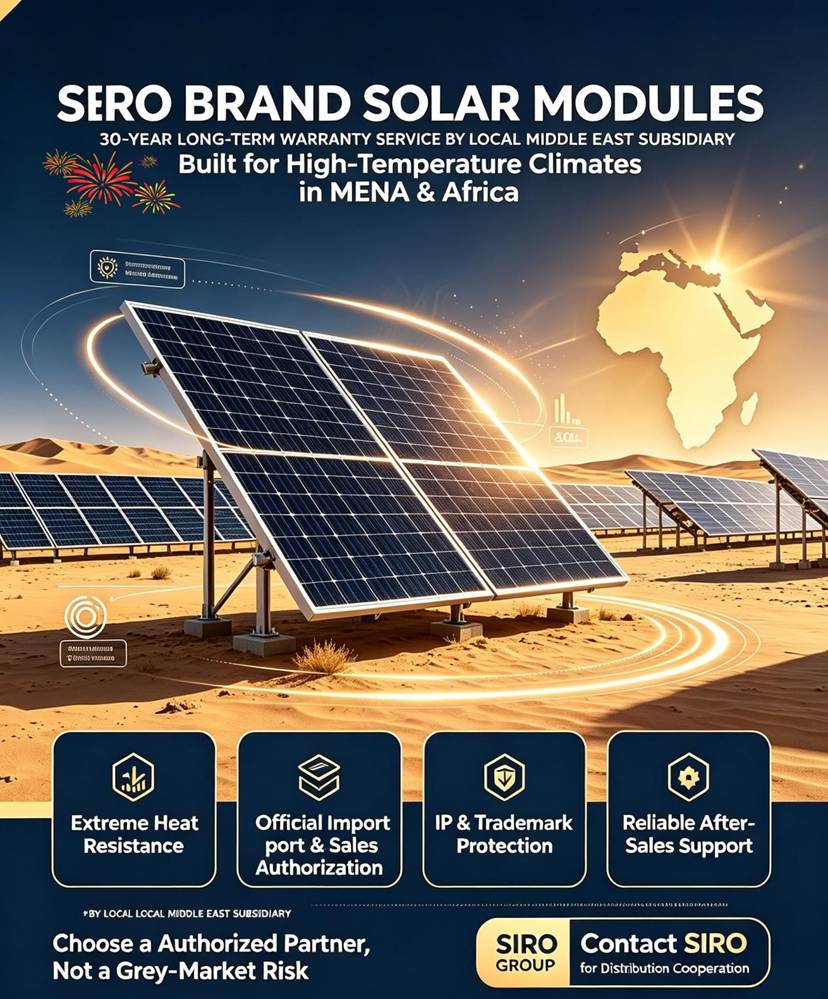
For importers, EPC contractors and local installers, selecting a legally authorized, heat‑resistant and fully supported brand determines long‑term profitability and operational safety. SIRO GROUP has built solid market leadership across the MENA and African solar sectors, with field‑proven high‑temperature stable modules, complete local technical backup and standardized global authorization systems. This FAQ explains the core strengths of SIRO solar panels and the critical risks of unauthorized grey‑market supplies.
Q1: Why is high‑temperature performance the top purchasing factor for solar projects in MENA and Africa?
Standard solar panel testing is carried out at 25°C, which rarely reflects real desert operating conditions. When the module temperature rises above 60°C, conventional products suffer obvious voltage drop and power loss, with output declining continuously throughout the hottest midday hours when power demand peaks. Long‑term thermal cycling also creates tiny cracks inside cells, breaks sealing layers and induces Potential‑Induced Degradation (PID), shortening service life and cutting total power generation over 25 years.
Sand and dew worsen aging. Cheap generic panels adopt ordinary EVA encapsulation and loose frame sealing. Dust accumulates easily, moisture penetrates and corrosion gradually damages internal circuits. Many distributors only compare initial wattage prices and overlook heat durability, finally facing serious yield decline and frequent after‑sales complaints two or three years after installation. SIRO modules are engineered specifically for harsh hot‑arid environments, with optimized temperature coefficients, PID‑resistant packaging and anti‑sand frame design to maintain stable power output under sustained high heat.
Q2: What technical advantages make SIRO solar panels reliable in extreme heat?
SIRO adopts automated DCS intelligent production lines and double EL inspection before and after lamination to eliminate invisible micro‑cracks. We deploy premium N‑type cells and high‑performance POE encapsulant instead of regular EVA film, greatly resisting ion migration and PID failure under high temperature and humidity cycles.
Our modules feature an excellent temperature coefficient, minimizing power loss as heat rises. Reinforced aluminum frames and dense edge sealing block sand and moisture intrusion. Every batch passes strict accelerated aging tests including thermal cycling, damp‑heat and UV aging, complying with IEC, TUV and CE international standards required by Middle Eastern and African customs and local energy authorities.
Field data from large projects in Nigeria and Bangladesh proves that SIRO panels maintain far lower annual degradation than budget generic competitors. Even after years of continuous exposure under intense desert sunlight, power attenuation stays within the guaranteed range, protecting investors’ long‑term returns.
Q3: What risks do distributors face when buying unauthorized solar panels in markets like Iran?
This is the biggest hidden danger for local solar operators. Many well‑known international brands do not issue formal import and sales authorization for Iran and several regional markets. Some traders source products through informal channels and sell them without legal brand permits. This business model brings three major threats.
First, intellectual property and trademark risks. Unlicensed goods may be judged as infringing products. Customs detention, confiscation, fines and market‑place seizure can happen at any time, causing huge capital losses and disrupting project schedules. Local customers may file complaints, dragging distributors into long and costly lawsuits.
Second, empty warranty commitments. Original manufacturers reject after‑sales service for non‑authorized parallel imports. Once panels suffer heat‑caused failures, micro‑cracks or power fading, local dealers cannot obtain official spare‑part supply, technical diagnosis or valid warranty compensation. Promises of a 25‑year performance guarantee become meaningless. The whole after‑sales burden falls completely on the importer, damaging business reputation and triggering customer claims.
Third, unstable product quality and inconsistent batches. Grey‑market inventories often come from multiple scattered factories without unified quality control. Specifications, raw materials and testing standards fluctuate frequently. For large commercial and utility‑scale solar farms, inconsistent reliability may lead to underperformance of the entire array and failure of project acceptance.
Many Iranian solar wholesalers and installers learned painful lessons: low upfront procurement costs are offset by legal penalties, endless customer disputes and unclaimable losses. A cheap unauthorized supply chain turns into a high‑risk trap.
Q4: How does SIRO solve these trademark and after‑sales pain points for MENA distributors?
SIRO builds transparent, standardized authorized distribution networks in target countries. We provide official brand authorization certificates, complete customs documentation and certified technical dossiers that meet local regulatory requirements, helping partners avoid grey‑import legal risks. Every authorized dealer receives formal sales rights and clear trademark use guidelines, fully compliant with regional intellectual‑property laws.
Beyond paperwork, SIRO maintains strong local technical and after‑sales presence in the Middle East. Our regional support team delivers pre‑sales system design, on‑site installation guidance, periodic performance inspection and rapid fault diagnosis. For large‑scale projects, we arrange spare‑part reserves and timely warranty processing. Unlike remote factories that only respond by email, our localized service system delivers practical support when field emergencies occur.
Dozens of long‑term partners across the Middle East and Africa confirm that SIRO’s stable quality, clear authorization and accountable after‑sales greatly reduce operational uncertainty. Distributors no longer need to worry about warranty abandonment or trademark infringement charges.
Q5: Why should MENA and African solar wholesalers choose SIRO instead of low‑cost generic factories or unauthorized imported famous brands?
Generic cheap panels look attractive at first sight, yet poor heat resistance leads to heavy long‑term losses. Unauthorized famous‑brand goods carry legal and after‑sales landmines. SIRO offers a balanced, secure middle path: reliable desert‑grade high‑temperature performance, internationally recognized certifications, legally protected distribution status and a mature regional service system.
We are not merely a component supplier. We cooperate with distributors as long‑term strategic partners, providing marketing materials, product training, customized packaging and flexible project quotation policies. Our completed large‑scale solar supply and installation cases in Nigeria and Bangladesh demonstrate our capability to handle bulk orders and complex field conditions.
The solar market in the Middle East and Africa keeps expanding rapidly. Competition is shifting from simple price rivalry to reliable quality, legal compliance and sustainable after‑sales support. Choosing a brand with genuine authorization and proven hot‑climate durability determines whether your solar business can grow steadily for decades.
Q6: How can I join SIRO’s authorized distribution network for MENA and African markets?
SIRO is actively selecting qualified local importers, EPC companies and solar installers to expand our official partner network across the Middle East, especially Iran, neighboring Gulf countries and major African markets. We welcome serious distributors to contact our international team for detailed authorization terms, product catalogues, sample application procedures and after‑sales agreements.
We carefully screen each partner to maintain orderly regional markets and protect dealers’ profit space. If you want to escape trademark disputes and invalid warranty traps and supply truly heat‑resistant, trustworthy solar modules to local farmers, commercial clients and power plants, SIRO is your dependable long‑term manufacturer ally.
Closing Summary
Extreme heat is the primary technical challenge for solar power in MENA and Africa, while unauthorized grey imports represent the biggest commercial risk. SIRO solar modules combine high‑temperature‑resistant industrial design, strict quality control, official trademark authorization and localized after‑sales service, solving both technical failure risks and legal pitfalls that trouble most regional distributors.
As solar demand continues to surge across hot climate zones, partnerships built on legality, reliability and long‑term technical support will win the market. Contact SIRO today to explore authorized cooperation and bring durable, high‑yield solar solutions to your local market.